This article was published in the Read the Label series at Cosmetics & Toiletries.
Hair bonding technology
Olaplex first launched its transformative hair bond building technology in 2014. Its patented bifunctional dimaleate molecule1 creates covalent bonds between thiol groups that remain when disulfide bonds are broken in damaged hair.2,3 These bonds can be broken by oxidative processes such as bleaching and permanent coloring, by reductive chemical services such as perming and relaxing, and by prolonged thermal stress.4 Before Olaplex, the standard approach to repairing chemically damaged hair was surface treatment with proteins and conditioners. The Olaplex technology was novel and it created a new product category: the hair repair bond building products.
Olaplex was clearly different from other market products at the time. It won a protracted patent battle against L’Oreal which commercialized similar chemistry. However, in the decade since Olaplex launched, many competitors have entered the hair bonding category. Hair care brand K18, now owned by Unilever, launched a biomimetic oligopeptide designed to integrate covalently into the damaged keratin structure, reconnecting broken polypeptide chains as well as disulfide bonds, which is claimed to give it a long lasting benefit.5 Recently, consumer goods giant Henkel agreed to acquire Olaplex to add to its portfolio of hair care brands.6
Inspired by Olaplex, L’Oreal incorporated hair repair technology into its Redken and Matrix lines, and other brands launched similar products. The Redken technology works primarily by lowering the pH of the hair surface, which causes the hair to become smoother, and not by forming bonds between hair fibers.7
The Olaplex technology has been reviewed in detail in the trade press.2,8 In brief, the active ingredient, bis-aminopropyl diglycol dimaleate (BADGD), is thought to diffuse into the hair fiber during application and link with free thiol groups, which are the remnants of broken disulfide bonds. The maleate groups in the molecule react with the thiol groups and form new bridges between the keratin proteins. These linkages were shown to restore hair strength in vitro in damaged hair.5
However, there is no peer-reviewed clinical evidence that Olaplex’s patented active ingredient BADGD works to reduce hair damage.9 Reconnecting broken disulfide bonds was shown to be possible in vitro in tensile testing,3 and in house clinical testing by Olaplex showed hair strength improvements. On balance, the Olaplex repair mechanism probably works but its efficacy has not been conclusively demonstrated in an independent clinical study.
Olaplex product range
The Olaplex product line starts with the No.1 and No.2 products, which are exclusive to hair salons and not available in retail. These products are concentrates of the active ingredients that are blended directly into bleach or color treatments to prevent hair damage. The blending needs to be done at exact ratios of product to water, color or bleach, which is why they are not suitable for home use.
Before the launch of No.3 Plus, Olaplex offered the No.0 and No.3 products for use at home. No.0 is applied as a spray primer for dry hair before using No.3. The combination contained a high concentration of BADGD and took about 3 minutes to work. After No. 3, Olaplex recommended No.4, a maintenance shampoo that delivers low-level BADGD during the cleansing step and maintains the hair’s pH, and No. 5, a cationic conditioner containing Behentrimonium Chloride and Cetrimonium Chloride, both conventional cationic hair conditioners.
Olaplex No.6, 7, and 8 address additional hair repair mechanisms that add a protective silicone layer to make the hair surface hydrophobic and replenish depleted ceramides and lipids that may have been washed out by an aggressive shampoo. No.9 contains antioxidants said to protect against free radicals and pollution.
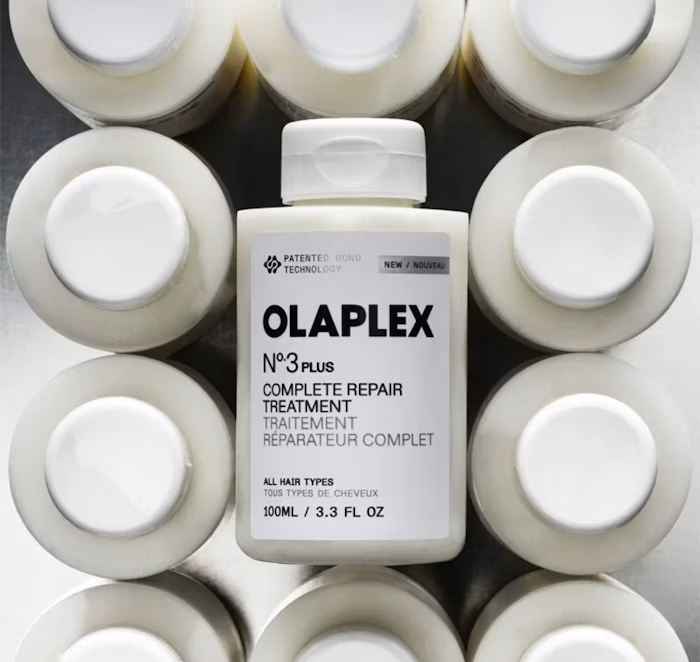
The new Olaplex No.3 Plus Complete Repair Treatment was introduced in 2025 as a replacement for No.3 and No.0. The patented bond builder BADGD is in the formula at an effective level, and in addition the No.3 Plus formula includes cationic conditioners to protect the hair against damage, along with humectants and oils to reduce frizz and smooth the hair cuticles. Therefore, No.3 Plus repairs both the internal disulfide bonds and the surface structure of the cuticle. It accomplishes in a single 3-minute process what previously required two product applications.
Ingredients
The No.3 Plus is a highly complex emulsion formulation with over 50 ingredients. Several ingredients are multifunctional, for example by playing a role in emulsion stability and helping to create a rich texture.
The most important ingredient is the BADGD, the bond repairing active. It is fourth on the ingredient list, indicating that it is present at a functional level, not as a trace amount.
The emulsion base is composed of long chain fatty alcohols with a waxy consistency. Cetearyl Alcohol is in second place on the ingredient list after Aqua (water). It provides a creamy consistency to the emulsion. Other fatty alcohols are cetyl alcohol and stearyl alcohol, which build the oil phase and adjust the texture. The humectant and cosolvent propanediol appears early in the ingredient list, as does Hydroxypropyl Starch Phosphate, a modified starch that functions as a thickener and helps stabilize the emulsion. Polyhydroxystearic Acid is a common polymeric emulsifier.
Cationic ingredients in a hair care formula help condition the hair by selectively depositing on negatively charged sites, which are present on damaged areas of the hair cuticle. Olaplex’s “Damage Defense Cationic Complex” consists of Behentrimonium Methosulfate, which is at a high concentration in the formula. Other cationics are, in order of appearance on the ingredient list, Distearyldimonium Chloride, Behentrimonium Chloride, Quaternium-91, Cetrimonium Chloride, and Cetrimonium Methosulfate. Then there are cationic polymers that form a network structure on the hair: Hydroxypropyl Guar Hydroxypropyltrimonium Chloride, Guar Hydroxypropyltrimonium Chloride, and Acrylamidopropyltrimonium Chloride/Acrylamide Copolymer. The reason why so many cationic ingredients are used is to make sure that all the damaged sited on the hair are covered with cationic fims.
The humectants in the product function to attract and retain water. These are glycerin, panthenol, sodium PCA, propanediol and propylene glycol. Some are also hair penetration enhancers, film formers, and cosolvents.
A complex mixture of oils is present to aid in restoring hair lipids, from Butyrospermum Parkii (Shea) Butter to Crambe Abyssinica Seed Oil, various sunflower extracts such as Helianthus Annuus (Sunflower) Extract, Seed Oil, and Sprout Extract, Persea Gratissima (Avocado) Oil, and Cocos Nucifera (Coconut) Oil. Ethyl Linoleate and Ethyl Oleate are chemically close to the linoleid acid and oleic acid found in sebum that coats healthy hair and may have been stripped off the hair surface with repeated cleansing. Finally, Caprylic/Capric Triglyceride is a lightweight oil that spreads easily on the hair surface, enhancing spreadability and providing a lighter feel.
Bioactives in the formula are Caesalpinia Spinosa Fruit Pod Extract, an extract rich in tannins that deposit and bind to keratin on the hair surface. Rosmarinus Officinalis (Rosemary) Leaf Extract is an antioxidant that protects the oils in the formula from degradation. Other antioxidants are Tocopherol and Pentaerythrityl Tetra-Di-T-Butyl Hydroxyhydrocinnamate.
Finally, the preservative system is based on Ethylhexylglycerin, Caprylyl Glycol, Phenoxyethanol, and Sodium Benzoate, with Citric Acid as a pH adjuster. The formula is completed by various fragrances and colorants.
Conclusion
Olaplex No.3 Plus represents a significant advance from the previous Olaplex No.3, by combining a much richer oil complex with a sophisticated cationic conditioning system. It succeeds in addressing most components of hair damage at an affordable price of $34 for 250 mL (8.5 fl. oz.).
INCI list
Aqua (Water, Eau), Cetearyl Alcohol, Behentrimonium Methosulfate, Bis-Aminopropyl Diglycol Dimaleate, Hydroxypropyl Starch Phosphate, Propanediol, Distearyldimonium Chloride, Glycerin, Behentrimonium Chloride, Cetyl Alcohol, Stearyl Alcohol, Caesalpinia Spinosa Fruit Pod Extract, Panthenol, Butyrospermum Parkii (Shea) Butter, Crambe Abyssinica Seed Oil, Helianthus Annuus (Sunflower) Extract, Persea Gratissima (Avocado) Oil, Cocos Nucifera (Coconut) Oil, Helianthus Annuus (Sunflower) Seed Oil, Quaternium-91, Oryza Sativa (Rice) Bran Extract, Caprylic/Capric Triglyceride, Ethylhexylglycerin, Hydroxypropyl Guar Hydroxypropyltrimonium Chloride, Rosmarinus Officinalis (Rosemary) Leaf Extract, Tocopherol, Helianthus Annuus (Sunflower) Sprout Extract, Caprylyl Glycol, Cetrimonium Chloride, Sodium PCA, Polyhydroxystearic Acid, Polyester-37, Ethyl Linoleate, Ethyl Oleate, Cetrimonium Methosulfate, Isopropyl Alcohol, Propylene Glycol, C13-15 Alkane, Guar Hydroxypropyltrimonium Chloride, Pentaerythrityl Tetra-di-t-butyl Hydroxyhydrocinnamate, Acrylamidopropyltrimonium Chloride/Acrylamide Copolymer, Phenethyl Benzoate, Sodium Bisulfite, Trisodium Ethylenediamine Disuccinate, Sodium Metabisulfite, Citric Acid, Phenoxyethanol, Sodium Benzoate, Parfum (Fragrance), Linalyl Acetate, Linalool, Hydroxycitronellal, Alpha-Isomethyl Ionone, Citronellol, CI 19140 (Yellow 5), CI 15985 (Yellow 6).
References
- Eric D. Pressly, Craig J. Hawker, “Methods for Fixing Hair and Skin”, U.S. Patent 9,095,518 (2015); Eric D. Pressly, Craig J. Hawker, “Keratin Treatment Formulations and Methods”, U.S. Patent 9,498,419 (2016); Eric D. Pressly, Craig J. Hawker, “Keratin Treatment Formulations and Methods”, U.S. Patent 9,668,954 (2017).
- Paul Cornwell, Jennifer Marsh, “How Bond Builders ‘Repair’ Hair”, Cosmetics & Toiletries 2023, February 27.
- Sami El Khatib, Dalal Hammoudi Halat, Sanaa Khaled, Ahmed Malki, Bassam Alameddine, “Novel Compounds for Hair Repair: Chemical Characterization and In Vitro Analysis of Thiol Cross-Linking Agents”, Pharmaceuticals 2025, 18, 632. https://doi.org/10.3390/ph18050632
- Craig Bettenhausen, “Repairing hair, with the help of chemistry”, Chemical & Engineering News 2024, 102 (18), June 14.
- Eva Martins, Pedro Castro, Alessandra B. Ribeiro, Carla F. Pereira, Francisca Casanova, Rui Vilarinho, Joaquim Moreira, Óscar L. Ramos, “Bleached Hair as Standard Template to Insight the Performance of Commercial Hair Repair Products”, Cosmetics 2024, 11, 150. https://doi.org/10.3390/cosmetics11050150
- Aimee Look, “Olaplex to Be Acquired by Germany’s Henkel for $1.4 Billion”, Wall Street Journal, March 27, 2026.
- Zoe D. Draelos, “Examining Bond-Building Hair Care Treatments”, Dermatology Times, August 2025 (Vol. 46. No. 08).
- Michelle Wong, “How Does Olaplex Hair Treatment Work?”, Lab Muffin Beauty Science. September 22, 2018. Accessed April 25, 2026. https://labmuffin.com/how-does-olaplex-hair-treatment-work/
- Taylor Graber, Calloway Cook, Brian Moore, “Olaplex Review: Is Hair Repair Possible?”, Illuminate Health blog, May 17, 2025.